Monday, October 31, 2011

Fantasy Football Start \ Sit

Post image for Fantasy Football Start \ Sit

Last week we had a rough go of it with an 8-8 in the Underachievers and 6-7 in the Overachievers.?? Let?s get to the rankings:

Overachievers

  • Christian Ponder (22)- He made more big plays in one game than Donovan McNabb did the past 2 years and gets an awful Carolina Panthers defense.
  • Joe Flacco (12) ? He is coming off an awful Monday night performance but the Arizona Cardinal defense is the prescription to get better.
  • Lance Ball (44)- He is now the goal line option and with Detroit struggling to stop the run he should be able to get you some bye week points.
  • Roy Helu (30)- He led the Washington RB?s in snaps last week and with Tim Hightower out for the year his role should expand.
  • Peyton Hillis (27) ? The 49ers defense is very strong but a well rested Hillis will get plenty of opportunity.
  • Michael Jenkins (35)- He was the #1 option for Ponder last week and should continue getting a ton of targets.
  • Antonio Brown (32) ?Hines Ward is injured and the Patriots awful 32nd ranked pass defense waits.
  • Jabar Gaffney (26)- The Bills are another shaky pass defense and John Beck did not look awful last week.
  • Daniel Fells (19) ?He was Tim Tebow?s favorite target last week.

Underachievers

  • Matt Schaub (9) ? Jacksonville has been playing good defense the past 6 quarters and I expect a run heavy attack for the Texans.
  • Philip Rivers (10) ?He looks injured and is not close to where he was last week.
  • Andy Dalton (15) ?He has played very well but now has to go to maybe the toughest place to play in the NFL.
  • Maurice Jones Drew (9) ?With his 4 fumbles last week, they may shy away from a ton of touches and try to win on the arm of Blaine Gabbert.
  • Daniel Thomas (16) ?He has had one good game, is now banged up and playing against a now healthy New York Giants defense.
  • Ryan Torain (17) ?He gave you negative point totals last week, look anywhere else.
  • Knowshon Moreno (20) ?He is not well liked by this staff and expect a lot more Tim Tebow running than himself.
  • Montario Hardesty (21) ? He looked like he was running in quicksand with his under 3 yards a carry last week.
  • Bernard Scott (23) ? He is the #1 RB but playing a tough Seattle Seahawks run defense at home is a tough task.
  • Deangelo Williams (29) ?He has not gotten over 12 carries all year.
  • Vincent Jackson (8) ? He still does not look healthy and nor does the Chargers passing game.
  • Dez Bryant (11) ? He usually disappears in the 2nd half and I can see the Eagles forcing the passes somewhere else the entire game.
  • Pierre Garcon (20) ? I would stay away from any Colts players.
  • Mario Manningham (21) ? He has been a shell of himself compared to last year and Victor Cruz has cut into his targets.
  • Sidney Rice (22) ? He is another guy who does not look right health wise and of course his QB?s are terrible.
  • Reggie Wayne (25) ? Colts passing game is terrible.

Make sure you check your byes.? That is it for this week; we will be back early next week for the weekly free agent pickups and be sure to check out our fantasy football forum.

Be sure to check out our one week fantasy football league, with $100 in prize money this week.

Fantasy Mike

Source: http://feedproxy.google.com/~r/Jetnationcom/~3/_zL_lGhED94/

angola manny ramirez harvest moon alyssa campanella alyssa campanella chad ochocinco nbc

China paper says U.S. solar complaint driven by envy (reuters)

Share With Friends: Share on FacebookTweet ThisPost to Google-BuzzSend on GmailPost to Linked-InSubscribe to This Feed | Rss To Twitter | Politics - Top Stories Stories, News Feeds and News via Feedzilla.

Source: http://news.feedzilla.com/en_us/stories/politics/top-stories/155215572?client_source=feed&format=rss

hank williams jr hank williams jr tough love tough love patriots jets patriots jets wes welker

Sunday, October 30, 2011

Experts try to cast doubt in Jackson doctor case (AP)

LOS ANGELES ? The battle of scientific experts in the trial of Michael Jackson's doctor took a new turn late Thursday as defense lawyers made an 11th hour disclosure that their scientific expert has devised a new computer simulation shedding light on what killed the pop superstar.

Prosecutors told the judge they were surprised by the new development and need time to study the software program used by Dr. Paul White, a top expert on the anesthetic propofol. The judge agreed.

He said White could conclude his defense testimony Friday but he would give the prosecution the weekend to analyze the computer data before the star witness of Dr. Conrad Murray's defense is cross-examined.

"This is extraordinarily complicated material," said Superior Court Judge Michael Pastor.

The developments were gleaned at the end of the court day from a transcript of a lengthy private conference with lawyers in the judge's chambers.

The new twist means another delay in the trial's conclusion, the judge said, and he worried aloud, "I just don't know if we are going to start losing jurors."

"This jury is extraordinarily dedicated to the case," he said. "But they have lives and commitments."

Jurors were told at the outset that they would be finished with the trial Friday, Pastor said. Now, he said, he's not sure when the trial will conclude.

The defense, meanwhile, sought to shift blame to another doctor and a drug different from the anesthetic that killed Jackson. Murray's lawyers called an expert to testify that the star was addicted to a Demerol in the months before his death.

They suggested the singer's withdrawal from the painkiller triggered the insomnia that Murray was trying to resolve when he gave Jackson propofol.

Murray's attorneys claim the ultimate blame lies with Jackson himself, but they also sought to implicate his dermatologist in the drug-laced path to his June 2009 death.

They called White to the stand late in the day to cast doubt on a colleague's earlier testimony that Murray was responsible for Jackson's death.

Court recessed before White gave his central opinion. He did say he was "perplexed" after reading documents in the case about whether Murray administered the propofol dose that killed Jackson.

White noted that Murray described to police a very low dose of the drug. If that was true, White said, "I would not have expected Michael Jackson to have died."

White said if Murray did in fact put Jackson on an IV drip of propofol and leave him unattended, he could not justify it. White did not immediately offer an alternate theory of what happened.

Authorities contend Murray delivered the lethal dose and botched resuscitation efforts. Murray has pleaded not guilty to involuntary manslaughter in Jackson's death.

There was no mention of propofol during the testimony of Dr. Robert Waldman, an addiction expert who said he studied the records of Dr. Arnold Klein, Jackson's longtime dermatologist, in concluding the star was dependent on Demerol. Records showed Klein used Demerol on Jackson repeatedly for procedures to enhance his appearance.

No Demerol was discovered in the singer's system when he died, but propofol was found throughout his body.

Waldman relied on Klein's records from March 2009 until days before Jackson died. Waldman said he was not shown earlier records and didn't review a police interview of Murray about his treatment of the star.

Under questioning by Murray's lead lawyer, Ed Chernoff, Waldman said, "I believe there is evidence that he (Jackson) was dependent on Demerol, possibly."

Klein has emerged as the missing link in the involuntary manslaughter trial, with the defense raising his name at every turn and the judge ruling he may not be called as a witness because his care of Jackson is not at issue. He has not been charged with any wrongdoing.

But Klein's handwritten notes on his visits with Jackson were introduced through Waldman, who said Klein was giving Jackson unusually high doses of Demerol for four months ? from March through June 2009 ? with the last shots coming three days before the singer's death.

Over three days in April, the records showed Jackson received 775 milligrams of Demerol along with small doses of the sedative Versed. Waldman's testimony showed Klein, who also was Jackson's longtime friend, was giving the singer huge doses of the powerful drug at the same time Murray was giving Jackson the anesthetic propofol to sleep.

"This is a large dose for an opioid for a dermatology procedure in an office," Waldman said.

He told jurors the escalating doses showed Jackson had developed a tolerance to the drug and was probably addicted. He said a withdrawal symptom from the drug is insomnia.

On cross-examination, prosecutor David Walgren tangled with the expert, who was hostile to most of his questions. He elicited from Waldman that the law requires physicians to keep accurate and detailed records, which Murray did not. The doctor also said all drugs should be kept in a locked cabinet or safe where they could not be stolen or diverted by anyone.

Waldman said every doctor also must document when the drugs are stored and when they are used. Murray told police he kept no records on his treatment of Jackson.

Waldman, who has treated celebrities and sports stars at expensive rehab clinics, told jurors treatment can work if the addict is willing to admit a problem.

Several prosecution experts have said the propofol self-administration defense was improbable, and a key expert said he ruled it out completely, arguing the more likely scenario was that Murray gave Jackson a much higher dose than he has acknowledged.

Jackson had complained of insomnia as he prepared for a series of comeback concerts and was receiving the anesthetic and sedatives from Murray to help him sleep.

Murray's police interview indicates he didn't know Jackson was being treated by Klein and was receiving other drugs.

In response to questions from a prosecutor, Waldman said some of the symptoms of Demerol withdrawal were the same as those seen in patients withdrawing from the sedatives lorazepam and diazepam. Murray had been giving Jackson both drugs.

White is expected to be the final defense witness.

White and Waldman do not necessarily have to convince jurors that Jackson gave himself the fatal dose, but merely provide them with enough reasonable doubt about the prosecution's case against Murray.

___

AP Entertainment Writer Anthony McCartney contributed to this report. McCartney can be reached at http://twitter.com/mccartneyAP.

Source: http://us.rd.yahoo.com/dailynews/rss/entertainment/*http%3A//news.yahoo.com/s/ap/20111028/ap_en_ot/us_michael_jackson_doctor

michael jackson dead prickly pear prickly pear jcole jcole j cole j. cole

Saturday, October 29, 2011

Union marchers swell ranks of OccupyMN protesters, join in march on banks (Star Tribune)

Share With Friends: Share on FacebookTweet ThisPost to Google-BuzzSend on GmailPost to Linked-InSubscribe to This Feed | Rss To Twitter | Politics - Top Stories Stories, RSS Feeds and Widgets via Feedzilla.

Source: http://news.feedzilla.com/en_us/stories/politics/top-stories/155137278?client_source=feed&format=rss

zip code finder zip code finder blackhawks daylight savings time 2011 tigers tigers rangers

Boeing's 787 Makes Its Inaugural Flight

Earlier Wednesday, Boeing's 787 made its inaugural flight from Tokyo to Hong Kong. The plane boasts greater fuel efficiency and a smoother ride, but also has a number of creature comforts ? like larger windows, better lighting and more overhead space. The plane is expected to be a game changer for aviation. Michele Norris speaks with AP aviation reporter Scott Mayerowitz, who was on the flight.

Copyright ? 2011 National Public Radio?. For personal, noncommercial use only. See Terms of Use. For other uses, prior permission required.

MELISSA BLOCK, host: From NPR News, this is ALL THINGS CONSIDERED. I'm Melissa Block.

MICHELE NORRIS, host: And I'm Michele Norris.

When it comes to flying, the thrill is gone. Instead of fun, we now have long lines, TSA pat downs, and legroom that seems to shrink each year. But there was quite a bit of excitement today when Boeing's much-anticipated 787 made a four-hour, eight-minute flight from Tokyo to Hong Kong. The new long-haul jet has been called the iPod of the Sky, with its sleek design and impressive fuel efficiency. The plane is built from lightweight composite plastic reinforced with carbon fibers.

Two-hundred-forty passengers were on today's maiden voyage and we were fortunate to track down one of them. His name is Scott Mayerowitz. He's a reporter for the AP. Welcome to the program.

SCOTT MAYEROWITZ: Thanks for having me.

NORRIS: Do me a favor, first. Describe this plane. What does it look like?

MAYEROWITZ: The very basic, it's a regular plane. But then you walk inside and there's a sort of open arching space. They call it the dome. And your eyes just naturally gravitate up. And there are sort of sleek edges to everything, nice colors, and you suddenly feel like, oh, maybe this isn't going to be so bad. You walk a few rows back, find your seat and there's a giant window next to you. Yeah, the seat is just the same old uncomfortable seat as you've had for many flights. But you got this big window and you're too busy playing with it...

(SOUNDBITE OF LAUGHTER)

MAYEROWITZ: ...you don't realize what's around you. The overhead bins are really big and you just kind of ease your bag into the bin. You close it and you're sort of looking up at this larger ceiling. The engineers tell me it's not that much higher. But it feels that much higher just because of the way it's designed.

NORRIS: Now, I want to go back to the windows because there's a lot of talk about these windows. They're bigger than the standard, small, sort of 8 x 11 sized windows in most planes. How big are they?

MAYEROWITZ: They are about 30 percent bigger than in a normal plane. And it lets in a lot more light. And the really cool thing, there are no shades on them. If you've got direct sunlight coming in, all you have to do is press a little button and there are five different levels where you can add tint to the window. It's sort of like those sunglasses you see people wear, that to go from clear to very dark in just a few minutes.

NORRIS: Now, the wings on this plane are a little bit different. On take off, they actually move and slightly arc in a way that a bird's wings might. Could you describe that for us?

MAYEROWITZ: It's a little bit of a flapping on the end. And then, as you come into flight, it just curves up. It's really cool. Look out the window and here's a very rigid piece of metal that's holding you and 239 other people up in the air. But yet it's bending in the wind. It's really an interesting sight.

NORRIS: Now, I've been asking you about the plane. I want to know a few things about the passengers. I understand there are people who paid a lot of money to be among the first to take this flight.

MAYEROWITZ: I was amazed. There were 116 passengers on the flight besides a bunch of media and dignitaries. Six of them had actually bid for business-class seats on them. One paid as much as $32,000 for his one seat. And then there was a couple that paid about 19,000 for their pair of seats. And they just said they love to fly. They think this plane is great and they want to be part of history.

NORRIS: Were they satisfied?

MAYEROWITZ: I think so. What I found really funny was they paid all this money for this business-class seat and they were back in coach with everybody else. They wanted to party. They wanted to talk to people. They wanted to experience the plane.

I've never seen such a long line for an aircraft bathroom before. Everyone wanted to check out the bathroom and use it. Part of it is there's a window in there, which is just really cool. And part of it is bigger difference, a lot more quiet bathroom. And these are the type of people who wanted to check that out.

NORRIS: I've been talking to AP reporter Scott Mayerowitz about Boeing's much-anticipated 787, which made its maiden voyage today from Tokyo to Hong Kong. Scott, thanks so much.

MAYEROWITZ: Thanks for having me.

Copyright ? 2011 National Public Radio?. All rights reserved. No quotes from the materials contained herein may be used in any media without attribution to National Public Radio. This transcript is provided for personal, noncommercial use only, pursuant to our Terms of Use. Any other use requires NPR's prior permission. Visit our permissions page for further information.

NPR transcripts are created on a rush deadline by a contractor for NPR, and accuracy and availability may vary. This text may not be in its final form and may be updated or revised in the future. Please be aware that the authoritative record of NPR's programming is the audio.

Source: http://www.npr.org/2011/10/26/141734192/boeings-highly-anticipated-787-makes-its-inaugural-flight?ft=1&f=1007

cleveland browns michael vick patriots heather locklear kenny britt matt hughes matt hughes

Friday, October 28, 2011

Climate change making country's water problems worse: expert (Reuters)

ERIE, Pa (Reuters) ? Climate change and population growth in the United States will make having enough fresh water more challenging in the coming years, an expert on water shortages said on Wednesday.

"In 1985-1986 there were historical (water level) highs and now in less than 25 years we are at historical lows. Those sorts of swings are very scary," said Robert Glennon, speaking at the State of the Lakes Ecosystem Conference in Erie, Pennsylvania.

Glennon, a professor at Arizona State University and the author of "Unquenchable: America's Water Crisis and What To Do About It," said that that according to climate experts, shorter, warmer winters mean less ice and greater exposure to the air, leading eventually to more water evaporation.

"We think about water like the air -- infinite and inexhaustible but it is very finite and very exhaustible," Glennon said.

"When you have a shorter ice season you have great exposure to the air and more evaporation. As temperatures go up it is very troubling," Glennon said. "The cycles are going to become more acute which is very troubling."

This past summer, Ohio Governor John Kasich vetoed a bill that would have allowed unrestricted removal of five million gallons of water from Ohio's lakes and rivers every 90 days.

Kasich, a Republican who has criticized government regulations, surprised some political observers by following the advice of organizations that felt the bill would allow lake levels to become dangerously low.

Glennon agrees the bill would have set the stage for diversion in other lakes. "It would have been open season on the Great Lakes."

Glennon doesn't believe that water diversion whether by pipeline, desalinization or more drilling are long-term answers. He thinks conservation, water reuse, and better agriculture practices bolstered by higher, seasonally-adjusted water costs will bring things in line.

"We pay less for water than we pay for cell phone service or cable television," he said. "All of our incentives are wrong."

The problem isn't just getting water to obviously needy areas like the desert city of Las Vegas, Glennon said. Areas with high rainfall and seemingly abundant freshwater sources also are increasingly exceeding capacity.

"The population of the U.S. is supposed to be 420 million by 2050," said Glennon, "Where are we going to get the water to support another 120 million Americans?"

(Editing by Mary Wisniewski and Jerry Norton)

Source: http://us.rd.yahoo.com/dailynews/rss/us/*http%3A//news.yahoo.com/s/nm/20111027/us_nm/us_climate_water

faith hill non hodgkin lymphoma lymphoma ciara world trade center memorial world trade center memorial spartacus

Thursday, October 27, 2011

Merkel presses private bondholders on Greece (AP)

BERLIN ? Chancellor Angela Merkel won the support of German lawmakers to increase the firepower of the eurozone's bailout fund Wednesday and indicated that private investors like banks should take losses of at least 50 percent on their Greek debt holdings.

The leader of Europe's biggest economy headed to a high-stakes summit in Brussels with a strong mandate to seal a deal on Europe's increasingly unmanageable debt crisis after winning a parliamentary vote 503-89, with four abstentions.

Yet uncertainty remained over whether European leaders would be able to nail down a comprehensive plan to solve the debt crisis.

"The world is watching Europe and Germany; it is watching whether we are ready and able, in the hour of Europe's most serious crisis since the end of World War II, to take responsibility," Merkel told parliament before the vote.

"It would not be justifiable and responsible not to take the risk," she added. "I do not have a better alternative."

Europe has already bailed out three small eurozone members ? Greece, Portugal and Ireland ? but fears it cannot bail out the troubled economies of Italy and Spain, the third and fourth largest economies in the 17-nation currency bloc. It also knows that the first bailout for Greece was nowhere near big enough to keep the country from defaulting.

With that in mind, European officials are working on several plans at once ? resolving Greece's debt situation, strengthening the continent's banks, which are expected to take deeper losses on their Greek bonds than they had planned, making sure other eurozone nations don't need bailouts and boosting the EU bailout fund itself.

"We have to take important decisions today," Luxembourg Prime Minister Jean-Claude Juncker, who also chairs the eurozone's finance minister meetings, said in Brussels. "But probably we will not be able to get all the smallest details in."

European Commission spokesman Olivier Bailly said it was too early to say whether there would be clear figures for writedowns on Greek debt or on the future firepower of the eurozone bailout fund, whose lending capacity is now at euro440 billion ($610 billion).

German opposition leaders briefed by Merkel say changes would take the fund's lending capacity above euro1 trillion ($1.4 trillion), but that has yet to be finalized.

Another open question was whether Italy will be able to convince its partners that it can get its economy back on track in return for help.

"Our Italian friends know exactly that we have to insist that tonight they tell us that we get important structural consolidation measures in Italy," Juncker said. "That is a must."

French President Nicolas Sarkozy's spokeswoman Valerie Pecresse said the French leader commits "all his energy toward the success of this summit," aiming to forge a comprehensive solution to tackle the crisis.

One key issue in Brussels will be renegotiating a deal made in July under which Greece's private bondholders agreed to accept losses of 21 percent on their holdings of government debt. That figure is now seen by EU governments as too little.

Merkel said the summit's aim must be a solution that allows Greece to cut its debt load to 120 percent of gross domestic product by 2020.

"That won't work without the private sector participating to a significantly higher extent" than was agreed in July, Merkel said.

She didn't spell out how much banks and other bondholders should contribute. But according to Greece's international creditors, a cut of 50 percent on the face value of Greek bonds now would take the country's debt to just above 120 percent of GDP.

Slovakia's outgoing Prime Minister Iveta Radicova joined Merkel's call, saying as she left for Brussels that investors' "writedown has to be higher than 50 percent."

A move to reduce the bonds' nominal value would significantly reduce the amount that Greece has to pay back when the bonds mature. It would go far beyond the tentative July deal, which focused only on lowering Greece's repayment rates and giving it more time to pay back its debt.

That would have reduced the financial pressure on Greece over the coming years, but would have done little to cut the country's overall debt load, which is set to spiral above an estimated 180 percent of economic output next year.

A global banking lobby group negotiating on behalf of private investors, the Institute of International Finance, said it had made a "significant new offer" on "a voluntary basis" Tuesday in the talks with European governments. Spokesman Frank Vogl did not give further details, and European officials said negotiations were still ongoing.

Merkel insisted that cutting Greece's debts alone won't solve the country's economic problems.

"Painful and necessary structural reforms must be implemented," she said.

She added that a "permanent surveillance" of Greece would therefore be "desirable." Athens' financial reform efforts have been monitored every three months by inspectors from the EU, European Central Bank and International Monetary Fund since it received a bailout in May 2010. Greece has opposed calls for a permanent surveillance mechanism.

Merkel didn't mention Italy, where Premier Silvio Berlusconi averted a government collapse to clinch an overnight deal on emergency growth measures demanded by the EU.

Berlusconi and coalition partner Umberto Bossi reached a compromise on raising Italy's retirement age ? a point of disagreement that had threatened Berlusconi's leadership.

Merkel stressed the need to make sure the crisis doesn't spread further, saying that recapitalizing troubled banks is necessary.

"Anyone who wants private creditors to participate in debt sustainability must also ensure that a screening off, a protection against the danger of contagion, is decided at the same time," Merkel told lawmakers. "Anything else is simply irresponsible."

The EU summit will consider plans to boost the euro440 billion ($610 billion) European Financial Stability Facility, or EFSF, by offering government bond buyers insurance against possible losses and attracting capital from private investors and sovereign wealth funds.

Germany, as the largest economy in the 17-nation eurozone, will be paying out a large share of the bailout money.

In her speech, Merkel stressed the EU must be prepared to overhaul its treaties to overcome the crisis for good and ensure a better functioning of the eurozone's 17 nations and the EU's 27 members.

A future treaty must allow that eurozone countries not living up to their fiscal and budgetary responsibilities under the bloc's growth and stability pact be taken to the European Court of Justice, she said.

Wednesday's joint resolution underlines the German parliament's expectations that, once the changes are implemented, the European Central Bank will no longer need to buy government bonds.

The ECB has bought about euro97 billion ($135 billion) in European government bonds August ? a move that has caused concern in Germany.

___

Gabriele Steinhauser in Brussels, Karel Janicek in Prague and Cecile Brisson in Paris contributed to this report.

Source: http://us.rd.yahoo.com/dailynews/rss/eurobiz/*http%3A//news.yahoo.com/s/ap/20111026/ap_on_bi_ge/eu_europe_financial_crisis

jeremy maclin nascar news emmys 2011 emmys 2011 boxing emmy nominations 2011 florida state football

Researchers ID genetic mutation associated with high risk of age-related macular degeneration

Researchers ID genetic mutation associated with high risk of age-related macular degeneration

Monday, October 24, 2011

Age- related macular degeneration (AMD) is the leading cause of severe visual loss among the elderly. Researchers had previously identified several relatively common genetic variants which together predict a person's increased risk for AMD, but a significant number of persons without the disease also have these variants. Now, for the first time, investigators have been able to clearly show a specific rare mutation called CFH R1210C that predicts a very high risk of disease and is extremely uncommon among individuals who do not have the disease. Although it is a rare variant, accounting for about 1% of the total cases, it is highly related to familial disease and earlier age of onset. This research is published online and in an upcoming print edition of Nature Genetics. The paper is a collaborative effort between investigators from Tufts Medical Center, Tufts University School of Medicine and Brigham and Women's Hospital.

"Our paper shows that there is a genetic variant that confers high risk of the development of AMD; this finding not only clearly links CFH gene dysfunction to disease, but also might help to identify people who need to be screened more closely," said first author, Soumya Raychaudhuri, MD, PhD, a researcher in the Divisions of Genetics and Rheumatology at Brigham and Women's Hospital and an Assistant Professor of Medicine at the Harvard Medical School.

Prior to this publication, it was known that genetic variation within the CFH gene influenced risk of AMD in individuals. In this study, researchers conducted sequencing and genotyping of CFH in 2,423 AMD cases and 1,122 controls in the laboratory of senior author Johanna M. Seddon, MD, ScM, Professor of Ophthalmology at Tufts University School of Medicine and Director of the Ophthalmic Epidemiology and Genetics Service at Tufts Medical Center. They identified a rare, high-risk mutation resulting in an arginine to cysteine substitution in the CFH protein. This mutation is associated with loss of function of the CFH protein and its discovery suggests that loss of CFH function can drive AMD risk. It was associated with advanced AMD with visual loss and many of the patients also had numerous drusen, which are the early hallmarks of AMD.

"The discovery of this rare but penetrant variant strongly associated with disease also points the way to developing new and effective treatments for high risk individuals," said Seddon.

Collaborators in this research included investigators from Massachusetts General Hospital and Johns Hopkins University.

###

Brigham and Women's Hospital: http://www.brighamandwomens.org

Thanks to Brigham and Women's Hospital for this article.

This press release was posted to serve as a topic for discussion. Please comment below. We try our best to only post press releases that are associated with peer reviewed scientific literature. Critical discussions of the research are appreciated. If you need help finding a link to the original article, please contact us on twitter or via e-mail.

This press release has been viewed 43 time(s).

Source: http://www.labspaces.net/114552/Researchers_ID_genetic_mutation_associated_with_high_risk_of_age_related_macular_degeneration

sarah mclachlan shakespeare bipolar symptoms qi osama bin laden osama bin laden main

Wednesday, October 26, 2011

Napoli, Rangers move 1 win from World Series crown

Texas Rangers' Mike Napoli hits a two-run double during the eighth inning of Game 5 of baseball's World Series against the St. Louis Cardinals Monday, Oct. 24, 2011, in Arlington, Texas. (AP Photo/Charlie Riedel)

Texas Rangers' Mike Napoli hits a two-run double during the eighth inning of Game 5 of baseball's World Series against the St. Louis Cardinals Monday, Oct. 24, 2011, in Arlington, Texas. (AP Photo/Charlie Riedel)

Texas Rangers relief pitcher Neftali Feliz and catcher Mike Napoli react after St. Louis Cardinals' Lance Berkman (12) is out at first to end the ninth inning of Game 5 of baseball's World Series Monday, Oct. 24, 2011, in Arlington, Texas. The Rangers won 4-2 to take a 3-2 lead in the series. (AP Photo/Matt Slocum)

Texas Rangers' Adrian Beltre hits a home run during the sixth inning of Game 5 of baseball's World Series against the St. Louis Cardinals Monday, Oct. 24, 2011, in Arlington, Texas. (AP Photo/Tony Gutierrez)

St. Louis Cardinals third base coach Jose Oquendo holds his hands up as Albert Pujols (5) stops at third on a hit by Matt Holliday during the seventh inning of Game 5 of baseball's World Series against the Texas Rangers Monday, Oct. 24, 2011, in Arlington, Texas. (AP Photo/Charlie Riedel)

St. Louis Cardinals starting pitcher Chris Carpenter throws during the first inning of Game 5 of baseball's World Series against the Texas Rangers Monday, Oct. 24, 2011, in Arlington, Texas. (AP Photo/Mike Segar, Pool)

(AP) ? Call it lucky, weird or just plain goofy. Whatever, Mike Napoli and the Texas Rangers are suddenly one win away from their first World Series championship.

And the St. Louis Cardinals? Perhaps next time they should try texting the bullpen.

In a Game 5 that took several odd twists at the end, Texas turned a grounder that got away and a telephone mix-up into its biggest victory ever. Napoli delivered the latest clutch hit of his charmed season, lining a tiebreaking two-run double in the eighth inning that sent the Rangers past St. Louis 4-2 on Monday night for a 3-2 edge.

Next up for Texas, a trip to St. Louis and a chance to capture that elusive crown.

"We certainly won't be out there thinking about we've just got to win one game," Texas manager Ron Washington said. "I've been there before, and that doesn't work."

Napoli's go-ahead stroke came off Marc Rzepczynski, right after a potential double-play ball slipped away from the St. Louis reliever. More bruising, at least to the Cardinals: Rzepczynski wasn't even supposed to face Napoli.

Cardinals manager Tony La Russa said he called down to the bullpen earlier in the inning and wanted Rzepczynski and closer Jason Motte to get ready. Instead, bullpen coach Derek Lilliquist heard only Rzepczynski at first. La Russa called again to ask for Motte and this time Lilliquist heard "Lynn," as in reliever Lance Lynn.

"I was more frustrated the double-play ball went off the glove and the fact we had numerous chances to add runs. That's probably more frustrating," La Russa said.

"The other part just happens. I mean, it's loud down there, and sometimes you call down there and you have to wait until the crowd and a guy gets up late. I mean, this is not unusual," he said.

Said Lilliquist: "You get a bunch of people, and it's loud."

"He wanted Motte going easy to back Zep up and I thought I heard Lynn. It transpired from there," he said. "It's basically miscommunication. It was loud. A lot of places are like that. The phone is as good as any phone anywhere."

The right-handed Napoli, meanwhile, was dialed in to face the left-handed Rzepczynski with the bases loaded, one out and the score 2-all.

"I didn't really see anybody warming up in the bullpen, so I kind of figured I was going to face him," Napoli said.

"Just trying to get something to the outfield, you know, get a sac fly, get that run across the board," he said. "I was trying to stay short and I got a pitch I could handle over the middle of the plate and put it in the gap."

Texas will try to wrap it up in Game 6 on Wednesday night in St. Louis, with Colby Lewis facing Jaime Garcia. The weather forecast for Busch Stadium is daunting, calling for rain and temperatures around 50.

After Napoli put Texas ahead, the slugging catcher capped off his night of double duty by throwing out a would-be base stealer in the ninth as Albert Pujols struck out.

"Pujols is going to put it in play, he's a good contact hitter," Napoli said, "and they were just starting the runner, 3-2. As soon as I got it, I just got rid of it and put it on the bag."

In the seventh, Napoli threw out Allen Craig at second with Pujols at the plate. Apparently, Pujols put on his own hit-and-run, then didn't swing.

If the Rangers eventually do win it all, the Texas fans who stood and chanted Napoli's name may forever remember his two-run hit.

If the Cardinals lose, there's no doubt which play will stick with La Russa for a long, long time.

It was tied when Texas put runners on first and second with one out in the eighth, and Rzepczynski was summoned. David Murphy followed with a bouncer back to the mound, a possible inning-ending double play in the making.

But the ball appeared to glance off Rzepczynski's hand and trickled harmlessly away for a single that loaded the bases. In the dugout, La Russa immediately threw his hands to his head, a true "Oh, no!" moment.

Napoli, who came close to a three-run homer in his previous at-bat and hit a big homer in a Game 4 win, sent a drive up the alley against the pitcher with the nickname "Scrabble." The double off Rzepczynski sure spelled good things for Texas, with the excitable Washington waving the runners around from the dugout.

Darren Oliver earned the win and Neftali Feliz closed for his second save of the Series and sixth of the postseason.

Adrian Beltre and Mitch Moreland hit solo home runs off Cardinals ace Chris Carpenter, helping Texas come back from an early 2-0 deficit.

Later, it became a battle of the bullpens and Texas prevailed.

Octavio Dotel gave up a leadoff double to Young in the eighth, struck out Beltre and intentionally walked Nelson Cruz. That left it up to Rzepczynski, and the game quickly slipped away.

La Russa appeared stunned by the turnaround. Later in the eighth, because of the mix-up, he brought in Lynn and had him issue an intentional walk to the only batter he faced. Motte eventually ended the inning, but it was too late.

Fittingly, Napoli had a role in the final play. Lance Berkman struck out and the ball hit Napoli's shin guard and trickled up the first base line, where the catcher picked it up and tossed to first base to end the game.

Pujols drew three intentional walks, including a pass with two outs and none on in the seventh. The St. Louis slugger then nearly used his legs to put his team ahead.

Pujols was running hard on a 3-2 pitch that Matt Holliday hit for a single to left-center. Pujols chugged around the bags and third base coach Jose Oquendo initially waved him home, only to put up a late stop sign.

Would Pujols have been safe on shortstop Elvis Andrus' wide throw to the plate? Maybe. But it became moot when Berkman was intentionally walked to load the bases and David Freese flied out against Alexi Ogando.

Beltre's homer made it 2-all with two outs in the sixth. He dropped to one knee after following through on a meaty cut. He connected on a big curve from Carpenter, who had easily handled Josh Hamilton and Young to start the inning.

Beltre's other homers this October came in a bunch. He hit three in a first-round playoff game at Tampa Bay.

Napoli almost gave Texas a cushion later in the inning. With the crowd standing and chanting his name as "Nap-Oh-Lee" flashed on the scoreboard, the catcher's bid for a three-run homer was caught on the warning track in right-center field, just shy of the 407-foot mark.

The homer let Texas ace C.J. Wilson avoid becoming the first pitcher to lose four times in a single postseason. The eccentric lefty who alternates red and blue gloves between starts had another uneven outing, working around five walks.

Wilson walked six while losing Game 1 to Carpenter and the Cardinals.

Moreland atoned for some glove woes with a home run in the third, hitting a drive halfway up the second deck in right field.

The Cardinals scored twice in the second, cashing in two leadoff walks sandwiched around a wild pitch.

Yadier Molina notched his fifth RBI of the Series with a single that left fielder Murphy overran and fumbled for an error. Skip Schumaker followed with an RBI grounder to first that Moreland boxed around, preventing any chance at a double play.

NOTES: Playing on his 34th birthday, Rafael Furcal led off the game with a liner that 3B Beltre backhanded. Furcal started Game 4 the same way. ... Wilson matched the postseason record for walks ? 19 ? set by Cleveland's Jaret Wright in 1997. Wilson's 11 walks in the World Series are the most since Allie Reynolds in 1951. ... Pujols flied out on a 3-0 pitch to end the first. He swung at 15 of 37 pitches on 3-0 counts this season, going 4 for 8 on the balls he put in play. ... Cardinals reliever Arthur Rhodes turned 42. He's the oldest player to celebrate a birthday while playing in the Series. Jim Palmer was 38 in 1983.

Associated Press

Source: http://hosted2.ap.org/APDEFAULT/3d281c11a96b4ad082fe88aa0db04305/Article_2011-10-25-BBO-World-Series/id-905b24cd52864f16b35d985419940a98

baby lisa irwin baby lisa irwin pearl jam 20 martha marcy may marlene lacuna lacuna paranormal activity 3 trailer

Antidepressant linked to developmental brain abnormalities in rodents

ScienceDaily (Oct. 24, 2011) ? A study by researchers at the University of Mississippi Medical Center (UMMC) and the University of California, San Francisco (UCSF) shows that rats given a popularly prescribed antidepressant during development exhibit brain abnormalities and behaviors characteristic of autism spectrum disorders.

The findings suggest that taking a certain class of antidepressants known as selective serotonin reuptake inhibitors -- SSRIs -- during pregnancy might be one factor contributing to a dramatic rise in these developmental disorders in children.

"We saw behaviors in the treated rats and neurological problems that indicate their brains are not properly conducting and processing information," said Rick C.S. Lin, PhD, professor of neurobiology and anatomical sciences at UMMC and principal investigator on the study.

"However, based on this study alone it, would be premature to conclude that a pregnant mother should stop taking SSRIs. A pregnant mother may do more harm to her baby through untreated depression than by taking prescribed SSRIs. This study is a starting point and a lot more research needs to be done."

The study appears online Oct. 24, 2011 in the Proceedings of the National Academy of Sciences.

The researchers treated more than 200 rats with the SSRI citalopram during key stages of brain development. Rats are born at an earlier developmental stage than humans, equivalent to the end of the sixth month of fetal development in humans.

Most rats received treatment for two weeks, beginning eight days post birth, a neurodevelopment period equivalent to the third trimester and early infancy in humans.

In contrast with control-group rats, the investigators found the treated populations were uninterested in play when young and displayed poor social behaviors as adults. The treated rats also showed abnormal responses to changes in their environment. For example, they froze at the sound of a novel tone and showed little interest in exploring new toys.

"These results demonstrate that rat pups, when exposed perinatally to SSRIs, exhibit behavioral traits often seen in ASD," said Kimberly Simpson, PhD, the paper's first author and UMMC associate professor of neurobiology and anatomical sciences.

Those behaviors occurred more often -- and sometimes exclusively -- in the treated male rats than in treated females. Similarly, autism spectrum disorder, or ASD, is diagnosed more often in males.

Of numerous SSRIs available, the researchers chose citalopram because it is one of the most specific in targeting the serotonin system with little overlap on other neurotransmitters.

Michael Merzenich, PhD, UCSF professor of otolaryngology and physiology, analyzed the rats' primary auditory cortices using electrophysiologic techniques. In the treated, month-old rats Merzenich found functional abnormalities consistent with ASD.

"What we see in this experiment is a strong impact on the auditory cortex. These animals are not maturing in the normal, progressive way, and those differences are substantial," said Merzenich, a senior author on the paper. "The cortex is sluggish and represents sounds with low accuracy. The listening cortex is delayed in development and is impaired into adulthood."

Delayed development of the representation of aural speech is a hallmark of ASD in children, Merzenich said. It contributes to these children's struggles with language and reading.

Another brain abnormality common in ASD is a thinner corpus callosum, particularly in the forward third of the structure. Like a massive nerve-fiber bridge, the corpus callosum connects the brain's two halves and transmits electrical signals between them. It also plays a key part in higher intellectual function, said Ian Paul, UMMC professor of psychiatry and human behavior.

"This nerve fiber tract was disrupted in the same way in these rats' brains," he said.

Many callosal axons in the treated rats had abnormal or missing myelin sheathing, a coating necessary for proper neuroconductivity.

"Without that myelin wrapping the signal slows or doesn't get through at all. The abnormalities in these rats would suggest the left and right sides of their brains are not communicating properly," said Paul, a senior co-author on the paper.

Lin said the researchers analyzed multiple aspects -- behavior, pathology, brain morphology, neurochemistry and neurophysiology -- to conduct a broad survey and get a sense of structural and functional abnormalities.

A $1.3 million EUREKA grant to Lin from the National Institute of Mental Health (NIMH) funded the study.

Opportunity to Study Autism Risks in Humans

The study in rats follows an epidemiologic study in humans, published in July in the Archives of General Psychiatry. That investigation found that children of mothers who took SSRIs during the year prior to giving birth ran twice the normal risk of developing autism.

"While one must always be cautious extrapolating from medication effects in rats to medication effects in people, these new results suggest an opportunity to study the mechanisms by which antidepressants influence brain and behavioral development," said Thomas R. Insel, MD, director of the NIMH. "These studies will help to balance the mental health needs of pregnant mothers with possible increased risk to their offspring."

The incidence of pregnant women taking SSRIs has grown from about .5 percent in 1985 when the first one came on the market to nearly 10 percent today, Paul said.

Autism was initially described in 1943 and through the next decades the parameters expanded. In 1996, the rate of incidence was less than 1 in 1,000 births and by 2007 it reached about 1 in 200. The rates of incidence of ASD have roughly doubled every three-to-five years to 1 in 91 currently, he said.

"The diagnosis has widened with the awareness that it's a spectrum disorder that encompasses a whole range of communication problems, but that doesn't account for all the increase by any means," Paul said.

Merzenich said a genetic component for autism risk is found in certain families, more strongly expressed in some members than in others.

"Genetic weakness can put a child at risk for autism origin," he said. The neurological distortions attributable to SSRIs plausibly add to the child's neurological burdens. We think that SSRIs may thereby increase the risks of ASD. In any event, further study in child populations should determine if this is or is not the case."

Lin cautioned that pregnant women shouldn't quit taking prescribed antidepressants based solely on the study's results.

"In this study, we eliminated as many external factors as possible. But real-life situations are much more complex," he said.

Stress hormones -- which affect the same neurological systems as SSRIs -- can also be detrimental to a developing baby, Simpson said, indicating another significant difference between the laboratory study and real-life situations.

"We intentionally looked for treatment effects in groups of rats that were considered normal at the beginning of the study and were birthed from normal mothers. The effects of SSRIs on babies carried by depressed mothers are not known," she said.

Lin also emphasized the findings call for more study of SSRIs, particularly in humans.

"We need to know which one causes minimal damage but also at what dose, for how long and at what points in pregnancy. So basically, we still have a lot to learn," he said.

He credited a multidisciplinary team of investigators for the work.

"This kind of work could never have been done in one lab," Lin said. "It's absolutely the result of a team approach that took people in pediatrics, pharmacology, neurobiology and anatomical sciences, psychiatry, physiology and otolaryngology."

Recommend this story on Facebook, Twitter,
and Google +1:

Other bookmarking and sharing tools:


Story Source:

The above story is reprinted from materials provided by University of California - San Francisco.

Note: Materials may be edited for content and length. For further information, please contact the source cited above.


Journal Reference:

  1. Kimberly L. Simpson, Kristin J. Weaver, Etienne De Villers-Sidani, Jordan Y.-F. Lu, Zhengwei Cai, Yi Pang, Federico Rodriguez-Porcel, Ian A. Paul, Michael Merzenich, Rick C. S. Lin. Perinatal antidepressant exposure alters cortical network function in rodents. Proceedings of the National Academy of Sciences, 2011; DOI: 10.1073/pnas.1109353108

Note: If no author is given, the source is cited instead.

Disclaimer: This article is not intended to provide medical advice, diagnosis or treatment. Views expressed here do not necessarily reflect those of ScienceDaily or its staff.

Source: http://feeds.sciencedaily.com/~r/sciencedaily/~3/aiXPmnqj38A/111024172742.htm

big east port charlotte florida buckyballs buckyballs jets gilad annie hall

Monday, October 24, 2011

Jared Bernstein: The Debt Crisis: It's All Connected, Man

Bill Marsh presents an interesting picture of interconnectedness in Sunday morning's New York Times. It's a great visual of the myriad connections through borrowing and lending across borders, but a few nuances to consider:

- Some folks who follow these numbers will be surprised to see US debt to GDP list as 100%. This is gross debt, including about 30% of GDP that the government owes to itself (more on that below).

The relevant metric for this picture should not be gross debt. It should be debt held by the pubic -- that's the number that markets care most about because that is a measure of our government's debt obligations to external creditors. According to CBO, debt held by the public as a share of GDP is expected to be 71% in 2012.

If you want to learn more about this important distinction, see this from the CBPP. As that analysis points out:

Such a focus on gross debt is seriously misguided and could inhibit the effort to address the nation's long-term fiscal challenges.


Debt held by the public consists of promises to repay individuals and institutions -- in the United States and abroad -- who have loaned the federal government money to finance deficits. Gross debt includes, in addition to the debt held by the public, so-called intragovernmental debt --money that one part of the federal government owes another part. More precisely, intragovernmental debt consists of promises to repay certain federal government accounts, such as the Social Security Trust Funds, for amounts they lent to the Treasury in years when their earmarked revenues exceeded their outgo for benefits and other costs.

Here's how CBO sees it:

Long-term projections of federal debt held by the public, measured relative to the size of the economy, provide useful yardsticks for assessing the sustainability of fiscal policies." In contrast, "gross debt . . . is not useful for assessing how the Treasury's operations affect the economy.

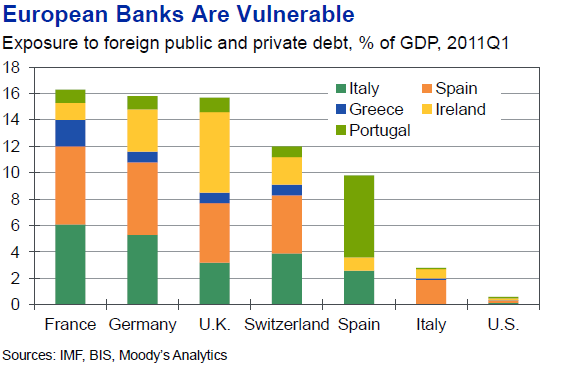
- The article states that American banks are heavily exposed to some of the countries with serious sovereign debt problems, including Spain, Ireland, and Italy. Not according to the figure below from Moody's. Which doesn't mean we're out of the European debt woods at all, however. Many US investors and funds are exposed, and we export a lot to the Eurozone. So contagion is a real worry, no question. But I don't think it comes mostly through our banks' exposure to the shaky debt.

2011-10-23-eurobanks.png


- The most important question about all this in the near term is what happens next. From where I sit, European negotiators are slowly and haltingly moving the in right direction, but the process is really quite disconcerting. You hear about progress toward the only solution that I think will work -- rip the band-aid off Greece, creditors take big haircuts, a robust fund to backstop exposed institutions -- only to read the next day that it's hit a wall.

- The second more important question is a medium-term one: what measures must be taken to avoid being back here again soon. From where I'm still sitting, that's a question about debt, and I mean at every level: households, corps, banks, governments. I'm convinced there's a global misunderstanding of the concept -- as Minsky discovered decades ago: "stability is unstable." With booms, come destabilizing debt bubbles that have us stuck in the economic equivalent of the shampoo cycle: bubble, bust, repeat.

More on this in a forthcoming piece I wrote for the journal Democracy.

This post originally appeared at Jared Bernstein's On The Economy blog.

?

Source: http://www.huffingtonpost.com/jared-bernstein/euro-debt-crisis-_b_1027519.html

apple iphone apple iphone chris christie cnet tampa bay rays netanyahu apple keynote

Sunday, October 23, 2011

monicaprelle: @KelleyRMcMillan hot springs and a six pack... #skiing #Apresski #california

  • Passer la navigation
  • Twitter sur votre mobile ? Cliquez ici m.twitter.com!
  • Passer cette ?tape
  • Connexion
Loader Twitter.com
  • Connexion
@KelleyRMcMillan hot springs and a six pack... #skiing #Apresski #california monicaprelle

Monica Prelle

Pied de page

Source: http://twitter.com/monicaprelle/statuses/127790707669860352

all my children online all my children online sly and the family stone sly stone the bling ring chelsea clinton facebook news

Autistic facial characteristics identified

ScienceDaily (Oct. 20, 2011) ? The face and brain develop in coordination, with each influencing the other, beginning in the embryo and continuing through adolescence. Now, University of Missouri researchers have found distinct differences between the facial characteristics of children with autism compared to those of typically developing children.This knowledge could help researchers understand the origins of autism.

"There is no clear answer about whether autism is caused by genetics or by environmental influences," said Kristina Aldridge, lead author and assistant professor of anatomy in the MU School of Medicine and the Thompson Center for Autism and Neurodevelopmental Disorders. "If we can identify when these facial changes occur, we could pinpoint when autism may begin to develop in a child. Knowing that point in time could lead us to identify a genetic cause, a window of time when the embryo may be susceptible to an environmental factor, or both."

Aldridge and colleagues found the following distinct differences between facial characteristics of children with autism and those of typically developing children:

  • Children with autism have a broader upper face, including wider eyes.
  • Children with autism have a shorter middle region of the face, including the cheeks and nose.
  • Children with autism have a broader or wider mouth and philtrum -- the divot below the nose, above the top lip.

She says these are subtle differences that will enable researchers to further study people with autism spectrum disorders.

Aldridge analyzed 64 boys with autism and 41 typically developing boys aged eight to 12 years old, using a camera system that captures a 3-D image of each child's head. Then, she mapped 17 points on the face, such as the corner of the eye and the divot in the upper lip. When Aldridge calculated the overall geometry of the face using these points, and compared children with autism and typically developing children, she found statistically significant differences in face shape.

Understanding that people with autism have statistically different facial characteristics enables researchers to focus on the underlying causes of autism, Aldridge said. Additionally, the study identified two groups of children with autism who show further distinct facial traits that occur in children with specific characteristics of autism, such as behavior problems, language level and repetitive behaviors. Identifying these subgroups within the group of children with autism allows better study of these children and why autism is so variable.

"This research would not be possible without the children and their families that participated," Aldridge said. "Their help is key to advancing research and helping us better understand autism, and how to develop better treatments. We are also indebted to the University of Missouri's Thompson Center for Autism and Neurodevelopmental Disorders for their support of this project and the care it provides for children with autism and their families in Missouri."

The study was published in Molecular Autism. Aldridge collaborated with Ian George, a graduate student in the School of Medicine; Kimberly Cole, a research technician at the School of Medicine; Jordan Austin, a senior in the College of Arts and Science; T. Nicole Takahashi, project director at the Thompson Center for Autism and Neurodevelopmental Disorders; Ye Duan, associate professor of computer science in the College of Engineering and the Thompson Center; Judith Miles, professor emerita in the School of Medicine and the Thompson Center. The entire team is affiliated with the Thompson Center. This research was supported by an Autism Spectrum Disorder Research Program grant, the Simons Foundation and the Thompson Center Research Scholar Funds.

Recommend this story on Facebook, Twitter,
and Google +1:

Other bookmarking and sharing tools:


Story Source:

The above story is reprinted from materials provided by University of Missouri-Columbia.

Note: ScienceDaily reserves the right to edit materials for content and length. For original reprint permissions, please contact the source cited above.


Journal Reference:

  1. Kristina Aldridge, Ian D George, Kimberly K Cole, Jordan R Austin, T Nicole Takahashi, Ye Duan and Judith H Miles. Facial phenotypes in subgroups of pre-pubertal boys with autism spectrum disorders are correlated with clinical phenotypes. Molecular Autism, 2011, 2:15 DOI: 10.1186/2040-2392-2-15

Note: If no author is given, the source is cited instead.

Disclaimer: This article is not intended to provide medical advice, diagnosis or treatment. Views expressed here do not necessarily reflect those of ScienceDaily or its staff.

Source: http://www.sciencedaily.com/releases/2011/10/111020105914.htm

oxford comma elisabetta canalis cedric benson lord howe island lord howe island conficker conficker

Saturday, October 22, 2011

Roommate in Rutgers suicide says no to plea deal

Dharun Ravi appears in court at the Middlesex County Courthouse during a hearing in the webcam-spying case involving the suicide of Rutgers University student Tyler Clementi, Thursday, Oct. 20, 2011, in New Brunswick, N.J. Ravi is one of two former Rutgers students accused of spying on Clementi's intimate encounter with another man days before the classmate committed suicide. (AP Photo/Julio Cortez)

Dharun Ravi appears in court at the Middlesex County Courthouse during a hearing in the webcam-spying case involving the suicide of Rutgers University student Tyler Clementi, Thursday, Oct. 20, 2011, in New Brunswick, N.J. Ravi is one of two former Rutgers students accused of spying on Clementi's intimate encounter with another man days before the classmate committed suicide. (AP Photo/Julio Cortez)

Dharun Ravi, second from left, walks out of the Middlesex County Courthouse with his attorneys after a hearing in the webcam-spying case involving the suicide of Rutgers University student Tyler Clementi, Thursday, Oct. 20, 2011, in New Brunswick, N.J. Ravi is one of two former Rutgers students accused of spying on Clementi's intimate encounter with another man days before the classmate committed suicide. (AP Photo/Julio Cortez)

(AP) ? A former Rutgers University student accused of using a webcam to spy on his roommate's intimate encounter with another man turned down a plea deal Thursday that would have limited his time behind bars to five years and could have kept him out of prison altogether.

Dharun Ravi, 19, affirmed his decision to go to trial, at which a conviction could mean 10 years or more in prison. A judge set a trial date of Feb. 21 for the case, which helped set off a national conversation about bullying of young gays and lesbians.

Tyler Clementi, an 18-year-old violinist in his first weeks at Rutgers, killed himself in September 2010, just days after the alleged spying. Ravi faces 15 criminal counts in all, including invasion of privacy and bias intimidation, a hate crime.

In the pretrial hearing Thursday to settle several issues about evidence, he remained silent, other than to say "yes" when New Jersey Superior Court Judge Glenn Berman asked him whether he understood the risks he faces by appearing in court.

Berman ruled that Ravi's lawyer should not have access to his personal writings, including documents found on his computer. Berman also ruled against a defense motion that he recuse himself because a distant relative who is a television producer told a New York Times reporter last month that she was interested in the case.

One key issue may not be resolved.

Berman reiterated his ruling of six months ago that Ravi, his lawyer and his lawyer's investigator should be given the name and birth date of the man who had the encounter with Clementi ? but with the caveat that they not give that information to anyone else.

Prosecutors objected to the disclosure requirement last month and asked Berman to reconsider.

On Thursday, the man, identified in court papers only as M.B., was represented in court by Richard Pompelio, a victims' rights lawyer who argued that his right to privacy outweighs Ravi's need to have information to defend himself.

Ravi's lawyer, Steven Altman, contended that the name of the man ? who is considered both a victim and a witness in the case ? is necessary for his client, even though the man has said he does not want to speak with defense lawyers.

"If you were standing where I am, wouldn't you want to learn what was in the mind of T.C.?" he asked Berman. "And what did M.B. know, what was he told, what wasn't he told? Who is he? Where is he from? Wouldn't you want to proceed to try to get that information?"

Pompelio argued that media exposure would harm M.B.

"Once they find out who he is, they find out his face," he said. "As the defendant knows, he has family and a web of relationships that are impacted by anything that happens to him. If his name gets out, it's out and it's out forever."

After court, Pompelio said he would not disclose any information about his client, including his age or occupation.

Berman said he was sensitive to M.B.'s right to privacy, but believes that Ravi should know who his accuser is.

"He'll never be stigmatized by any person who's thoughtful, balanced and fair," Berman said.

Julia McClure, a Middlesex County prosecutor, and Pompelio both said they intend to appeal that ruling.

Associated Press

Source: http://hosted2.ap.org/APDEFAULT/386c25518f464186bf7a2ac026580ce7/Article_2011-10-20-Rutgers%20Suicide/id-8933dbe3a6b4484d98fa657fa502baba

modern family troy davis troy davis cough crystal cathedral new facebook layout new facebook layout

PFT: Holmgren discusses future in Cleveland

Buffalo Bills v New York GiantsGetty Images

We?re taking a longer look at each team during their bye week. ?The 4-2 first place Giants are up.

The New Favorites

My preseason pick of the Giants as NFC East champs doesn?t look too crazy now. New York is the slight favorite in a wide open division because 1) They are ahead. 2) They don?t have RexJohn Beckman as their quarterback. 3) They have reason to believe they?ll get better.

The margin for error is slim. They are slight favorites, capable of winning (and losing) to anyone.

Reinforcements coming

The Giants started the season with a brand new offensive line. They?ve played without Pro Bowler guard Chris Snee at times. That group should continue to improve the more it plays together.

On defense, the front seven hasn?t had all its pass rushers together at the same time. Justin Tuck should be back after the bye. Osi Umenyiora has been solid since his return. ?The team also hopes to get first round pick cornerback Prince Amukamara back after the bye. He?ll add depth to a weak spot for New York.

Pass rush potential

I picked the Giants on one theory: They had enough offensive talent and no one could match their quantity of pass rushers. They lead the NFL in sacks. When Tuck is healthy, it will be tough to block him, Osi Umenyiora (5 sacks in three games), Jason Pierre-Paul (7 sacks), Mathias Kiwanuka, and Chris Canty.

Pierre-Paul should make the Pro Bowl this year. The defense hasn?t been great overall, but the pass rush gives this team an edge.

Giants Football means something different

Eli Manning is quietly having a nice season. He?s third in the league in yards-per-attempt. Victor Cruz has ably stepped up as a playmaker. Jake Ballard is doing a solid job at tight end. Throw in Hakeem Nicks and Mario Manningham, and it?s clear this is a passing team.

New York is 31st in yards-per-carry. ?This team is going to win by throwing.

Schedule is brutal

The Giants get the Dolphins coming out of the bye. That should get them to 5-2, but then they face as tough a schedule as any team in the league: @ NE, @ SF, PHI, @NO, GB, @ DAL. ? Yikes. It doesn?t even ease up in the final three much. ?(WAS, @NYJ, DAL).

The second place schedule was a disadvantage this year because they got the Saints and Packers. The rest of the NFC East has a tough schedule too. My guess is only one NFC East team gets in.

Source: http://profootballtalk.nbcsports.com/2011/10/20/holmgren-talks-about-how-long-hell-stay-in-cleveland/related/

kristin cavallari the others the others vitiligo los angeles weather portia de rossi portia de rossi